
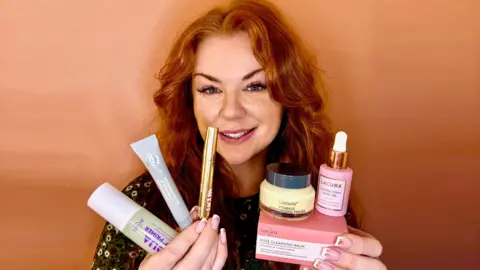
 Rachael Parnell
Upon hearing a consumer learned a discounter was offering a fresh product collection that seemed similar to products from premium company Augustinus Bader, she was "super excited".
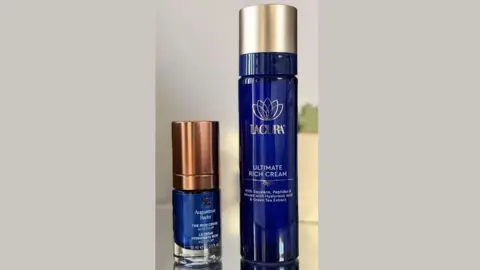
Rachael hurried to her local store to buy the supermarket face cream for under £9 for 50ml - a small portion of the £240 cost of the high-end 50ml item.
Its smooth blue packaging and gold lid of each creams look strikingly comparable. While she has never tried the premium cream, she claims she's impressed by the product so far.
She has been buying beauty alternatives from popular shops and grocery stores for a long time, and she's not alone.
Over a quarter of UK consumers report they've tried a skincare or makeup dupe. This rises to nearly half among younger adults, according to a recently published study.
Alternatives are skincare products that copy established companies and provide affordable substitutes to premium items. These products frequently have alike branding and containers, but sometimes the components can vary significantly.
 Victoria Woollaston
'Costly Isn't Necessarily Better'
Beauty specialists contend many alternatives to premium labels are reasonable quality and aid make skincare cheaper.
"In my opinion costlier is necessarily better," says skin specialist one expert. "Not every budget skincare brand is bad - and not all premium skincare product is the best."
"Certain [dupes] are truly impressive," notes a skincare commentator, who hosts a program featuring celebrities.
A lot of of the products modeled on luxury labels "disappear so fast, it's just unbelievable," he remarks.
 Scott McGlynn
Skin specialist a doctor thinks alternatives are fine to use for "simple routines" like hydrators and face washes.
"Alternatives will serve a purpose," he says. "They will perform the fundamentals to a reasonable degree."
Another skin doctor, advises you can save money when searching for simple-formula items like hyaluronic acid, Vitamin B3 and a moisturizing ingredient.
"If you're purchasing a single-ingredient product then you're probably going to be fine in opting for a budget alternative or a product which is quite affordable because there's very little that can cause issues," she explains.
'Don't Be Influenced by the Container'
Yet the professionals also recommend consumers check details and note that costlier products are at times worth the extra money.
With luxury skincare, you're not only covering the brand and advertising - often the increased cost also is due to the formula and their quality, the potency of the key component, the science used to produce the item, and trials into the products' effectiveness, the expert notes.
Skin therapist another professional says it's important considering how some alternatives can be priced so at a low cost.
Sometimes, she says they could contain filler ingredients that do not provide as significant positive effects for the skin, or the ingredients might not be as high-quality.
"One key doubt is 'Why is it so cheap?'" she says.
Commentator Scott says on occasion he's purchased skincare items that appear comparable to a big-name label but the product itself has "little similarity to the premium version".
"Do not be fooled by the outer appearance," he warned.
 SimpleImages/Getty Images
Regarding advanced items or ones with ingredients that can inflame the complexion if they're not formulated properly, such as retinoids or vitamin C, she advises sticking to medical-grade labels.
She explains these will likely have been through expensive studies to evaluate how efficacious they are.
Beauty items are required to be tested before they can be marketed in the UK, notes skin doctor another professional.
If the label advertises about the effectiveness of the product, it needs data to verify it, "however the manufacturer does not necessarily have to do the testing" and can alternatively reference testing completed by different firms, she adds.
Examine the Back of the Container
Is there any ingredients that could signal a product is inferior?
Ingredients on the back of the container are listed by concentration. "Ingredients to avoid that you want to look out for… is your mineral oil, your SLS, fragrance, benzel peroxide" being {high up


